Business Fire Alarm Installation Guide
A fire alarm system is part of the business security system that keeps your business, property, and employees safe. A fire can become life-threatening in two minutes and can engulf a building within five minutes. Your business could go up in flames in a matter of moments without the proper equipment and detection systems in place to protect everything you have built.
Get Familiar with Your Authority
Not only is a fire alarm system an excellent way to keep your business safe, but it is also the law. While there are slight variations in the codes and standards in each area, the “National Fire Alarm and Signaling Code” or NFPA 72 is the leading document published by the National Fire Protection Association (NFPA). NFPA 72 includes the most up-to-date safety considerations and requirements for your business’s fire alarm systems (as well as notification systems for other emergencies).
Your local Authority Having Jurisdiction (AHJ) consists of the people responsible for carrying out the requirements of a code or standard in your area. The knowledge of the AHJ extends to fire and emergency situations. The AHJ in your locality will be able to discuss and provide expertise on your business’s fire system requirements. To locate your AHJ, contact your fire or security company or check out your local government’s website.
Working with a reputable company like FSS Technologies that is familiar with local codes and ADA compliance requirements will make your fire alarm system installation as seamless as possible.
Fire Systems
Once you have explored the types of fire alarm systems and determined whether you would prefer a manual or automatic fire alarm for your business, you will need to understand the fire alarm installation process.
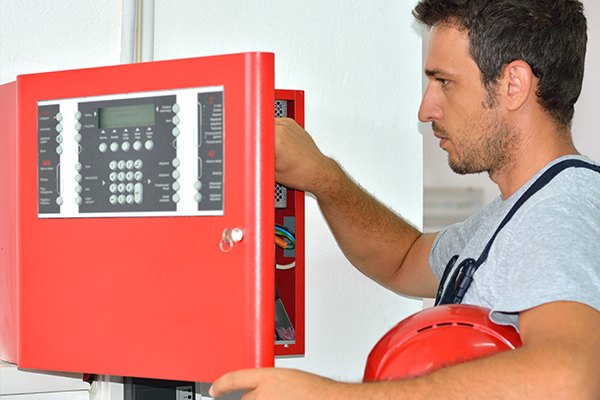
A fire alarm panel will be installed as a control center for your fire alarm system, acting as both the central processing unit and the equipment that communicates with alarms, sprinklers, and local authorities. The two most common fire panel types are conventional fire panels that are used as an early-warning system for occupants, and an addressable fire panel that allows more specificity in the reaction of the equipment within the building.
In addition to the control panel, some features of Commercial Fire Alarm Systems include:
Smoke detectors will need to be placed in specific areas of your building, as determined by your local AHJ. Smoke detectors spaced correctly will provide you with the best life and property protection.
This detector conveys advanced multi-sensor innovation and increases effectiveness, reduces costs, and increases your life and property well-being.
The detector combines the functionality of early smoke detection with carbon monoxide sensing capabilities. As a result of the detector’s double duty, your property is monitored continuously for any sign of fire and its deadly companion carbon monoxide.
Manual pull stations offer a positive pull-lever operation. One pull on the station handle breaks the glass rod and turns in a positive alarm, ensuring protection plus fool-proof operation.
In many larger buildings, you may hear an alert tone followed by a voice evacuation message.
ADA compliant devices can include low frequency audible horns and audible-visible appliances according to established visible device guidelines.
Two-way voice devices offer a way to communicate with a central station operation that can assist until the fire department arrives.
Fire alarm voice evacuation systems use speakers and amplifiers to notify occupants with an alarm tone followed by a voice instead of the traditional horn or bell.
Installation Day
At FSS Technologies, we know that as a busy business owner, you don’t want to waste your time or take up a whole day with fire systems meetings. We keep our meetings short and to-the-point, and at your convenience. Additionally, our fire alarm installations are quick and unobtrusive, with most lasting less than half a day.
Our expert technicians are always happy to answer questions and take as long as you need to feel comfortable operating your new system. Once we leave, we are just a phone call away if a question does come up.
Maintenance and Inspections
Fire alarm inspections are done to ensure your system is functioning. The National Fire Protection Association requires a third-party fire inspector to conduct your tests annually. However, depending upon your building code type and occupancy, you may be required to have it tested multiple times per year.
You should be testing your fire alarm yearly, at the very least. Still, it will be determined by the Authority Having Jurisdiction (AHJ) in your area, as they are the ones responsible for the fire codes in your locality.
If your system needs to be serviced, FSS Technologies guarantees service within 24 hours. Our technicians are NICET certified fire alarm technicians, so you know that you are getting expert assistance.
If you are interested in getting started with commercial fire systems, reach out to our team of experts! We will help you keep your business safe and protect your employees and investment.
Explore Our Other Blogs
How to Hide a Camera in Plain Sight
Hidden Security Cameras When it comes to security cameras, you can choose whether you want them installed in visible locations or have them hidden within your building. There are two different perspectives with this topic. Keep them in plain sight to deter crimes from occurring. Thieves are less likely to target your home or business if they…
7 NFPA Codes Every Business Should Know
Business owners have an enormous responsibility to ensure their employees and customers are protected from fire hazards. Companies in industries like manufacturing and property management each face unique challenges in preventing fires and meeting code requirements. The National Fire Protection Association (NFPA), one of the world’s leading experts in fire and life safety, has published…

Why Fire Alarm Monitoring is Essential for Your Business
We’ve talked about the National Fire Protection Association (NFPA) in previous blogs and how it is essential to understand and obey their standards when installing, testing, and maintaining fire alarm systems. Fire Alarm Monitoring is the Law Your business might need to include monitoring as part of its fire safety system due to NFPA 101® . NFPA…

7 Ways Home Monitoring Keeps Your Pets Safe
Your family’s safety is at the forefront of your mind when installing a security system, and that includes your pets as well. When researching a security product that suits your needs, consider the ways that this technology can help your pets stay safe too. We have detailed some of the most common hazards as well…
Code Requirements for Commercial Fire Alarms
The International Code Council The purpose of commercial property is for business or retail use, and the International Code Council (ICC) is a nonprofit association that develops model codes and standards used worldwide to construct safe, sustainable, affordable, and resilient structures. The fire codes vary depending on the type of business you run. For example,…
4 Questions & Answers about Smart Home Devices
Smart Home Technology Let’s face it; we are in love with our smartphones. According to Pew Research Center, more than 81% of Americans now own one; that is up from just 35% in 2011. With so much power in the palm of our hand, it’s not surprising that we want to use our smartphone for…

How Landscaping Affects Your Security
Visibility When it comes to the landscaping around your home or business, there are several considerations to keep in mind that could affect your visibility and overall security. While some suggestions to increase visibility and reduce obstructions may seem obvious, others are more subtle and could have a considerable impact. Lighting Having adequate lighting around…

Smart Home Technology for Aging Adults
Alzheimer’s Awareness Around 75% of seniors want to stay in their homes as they age, according to the American Association of Retired Persons (AARP), even if they need day-to-day assistance or have ongoing health issues like early-stage Alzheimer’s or dementia. According to the Alzheimer’s Association, 5.8 million Americans are living with the disease, and by…
Carbon Monoxide Detector Basics
What is a Carbon Monoxide Detector? Carbon monoxide (CO) is a colorless, odorless, and tasteless gas or liquid that is poisonous to humans. Detectors are designed to identify carbon monoxide leaks and warn those in your home or business. This advanced warning can save lives as it allows you to get outside as fast as…

How Do Fire Sprinkler Systems Work?
Fire sprinkler systems work by detecting heat from fires and releasing water to extinguish them. Different components work together in various configurations to boost a structure’s fire and life safety measures. Learn how a fire sprinkler system works, what your options are, and why it’s a necessary investment for your business. What are the main…