How Do Fire Alarm Control Panels Work
A fire alarm control panel is the brain of any commercial fire system. It constantly monitors connected devices, processes signals, and activates alarms when necessary. Understanding how a control panel works can help business owners, facility managers, and safety professionals recognize just how vital this piece of equipment is in protecting people and property.
What does a fire alarm panel do?
A fire alarm control panel receives information from initiating devices like smoke detectors, heat detectors, and manual pull stations. If part of the system is triggered, the panel activates notification appliances and fire sprinkler systems. If fire alarm monitoring is in place, the panel will also notify the monitoring service.
In addition to reacting to emergencies, the panel also supervises the health of the fire alarm system itself. It constantly checks for wiring issues, power failures, or device malfunctions, alerting building personnel if a problem arises. These panels often simplify the fire alarm inspection process as well.
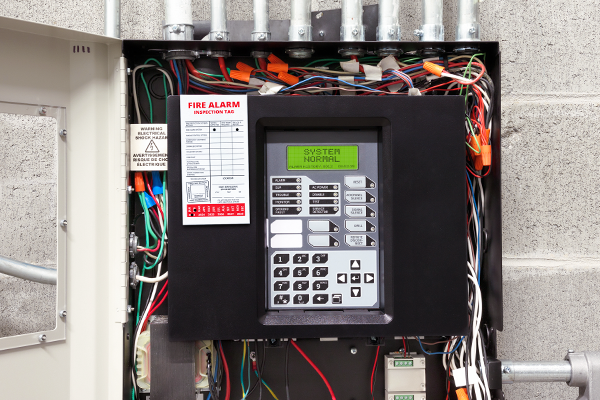
What components are connected to a control panel?
Several subsystems work together inside the panel:
- Power supply and backup: The panel connects to building power but also includes backup batteries. If power is lost, the panel can operate in standby and still sound an alarm for the time period required by NFPA 72.
- Initiating device circuits: These inputs connect to detectors and pull stations. In conventional panels, devices are grouped by fire alarm zones. In addressable panels, each device has its own digital “address.”
- Notification appliance circuits: These outputs control horns, strobes, or speakers that visually or audibly warn a building’s occupants of danger.
- Interface modules: Relays and modules allow the panel to communicate with other systems, such as sprinklers, elevators, and HVAC.
- User interface: Features like LED lights, an LCD screen, and control buttons allow operators to acknowledge alarms, silence signals, or reset the system.
What are the two main types of fire alarm control panels?
Most fire alarm panels fall into one of two categories:
- Conventional panels divide a building into zones. If an alarm occurs, the panel shows which zone is affected, but not which specific device triggered the signal. These systems are typically used in smaller structures, but Authorities Having Jurisdiction may approve them.
- Addressable panels assign a unique address to every device. When an alarm or fault occurs, the panel displays the exact device and its location. Addressable systems are more flexible and are common in larger or more complex buildings.
Are there different panel operation modes?
A fire alarm control panel can operate in several different modes, such as:
- Normal/standby: The panel monitors circuits and devices without alarms active.
- Alarm: When a device detects smoke, heat, or manual activation, the panel triggers notification appliances and may send signals to a monitoring center.
- Trouble: If the panel detects an issue such as a wiring fault, battery failure, or ground fault, it enters trouble mode and alerts building staff.
- Test: During maintenance, technicians can place the panel in test mode to verify that each device responds correctly without causing a complete building evacuation.

Can fire alarm panels integrate with other systems?
Modern fire alarm panels often integrate with building systems to support life safety:
- Shutting down the HVAC
- Releasing magnetic door holders
- Triggering elevator recall
- Activating fire suppression systems
This coordination ensures that when a fire occurs, the entire building responds in a way that protects occupants and supports emergency responders.
Protect your facility with FSS Technologies
Deciding on the best type of fire safety system for your facility and budget can be challenging. It requires a unique skill set to understand, design, install, and maintain these specialized systems. At FSS Technologies, we can take care of every aspect of your company’s fire prevention, protection, and suppression needs.
Whether you need a new fire alarm system, an upgrade to an addressable panel, monitoring services, or ongoing inspections, our NICET-certified team of expert technicians is here to help. With decades of experience and a commitment to code compliance, we provide the reliable protection your business deserves. Contact us to learn more.
Explore Our Other Blogs

Will CCTV Work Without Internet?
Closed-circuit television (CCTV) is a TV system where the signal isn’t publicly broadcast but is watched and monitored, usually for surveillance and security purposes. From city streets and highways to retail stores and banks, CCTV cameras are placed in most places to protect property and deter crime. Learn whether a commercial CCTV system can work…
Does My Business Need an Access Control System?
Does My Business Need an Access Control System? Before determining whether your business could benefit from an access control system, let’s go over the different types and their capabilities. In short, an access control system is a type of security system that lets you control who, where, and when someone can enter or exit your…

What to Know About Smart Locks
Smart locks have been on the market for several years and continually gain features as technology advances. Learn how useful they can be and how to find the best option for your home or business. What’s a smart lock? Smart locks are door locks controlled digitally. These locks can be monitored and controlled by an…
Lowe’s Iris Line Goes Under
Many consumers are seeing red with the recent news that big-box retailer Lowe’s is shutting down service to its Iris smart home platform. Lowe’s launched its Iris cloud service in 2012 so it could sell its own smart home products to the public. Customers with an Iris smart hub, the heart of the network, could…

Are You a Spectrum Customer Losing Service?
When Spectrum closed the doors on its home security system business in February 2020, many customers were left high and dry. The Spectrum Backstory Spectrum is a subsidiary of Charter Communications, the second-largest cable provider in the country offering service in 42 states. Charter inherited Spectrum in a 2016 merger with Time Warner Cable and Bright House…
What Is Alarm.com?
How Does Alarm.com Work? Alarm.com is a cloud-based service that allows customers to manage their security alarms and home automation systems remotely. Alarm.com does not manufacture security components, like alarm panels and cameras. Instead, its cutting-edge software is integrated into hardware systems provided by highly regarded manufacturers. What sets Alarm.com apart? Alarm.com Products Alarm.com’s partnership…
What Is CCTV Footage?
CCTV stands for closed-circuit television, in which video cameras transmit a signal to a specific, limited set of monitors. Wired and wireless cameras in a CCTV system are usually used for surveillance and security purposes. The footage can help prevent crime, aid in the capture of a suspect if an offense occurs, or serve as…

5 Ways Your DIY Security System is Failing You
In the digital age, DIY projects are the rage in all things, including home security. People turn to DIY home security because it seems easy and can save you a few bucks. Unfortunately, you really do get what you pay for if you choose a DIY security system. Whether you are a homeowner, a business owner, or…

5 Reasons Why You Need a Home Security System
A home security system protects your home and the ones you love. While there are many reasons you may need to invest in a home security system, we have highlighted some key ones: 1. Peace of Mind Have you heard a noise in the night and ever wondered what made the noise? A home security…
How to Deter Burglars From Your Business
Burglaries are often considered crimes of opportunity, leaving businesses struggling to recover in the aftermath. Although there is no all-powerful solution to protect your business, you can implement various preventative measures that bolster your security efforts. Here are 5 actions you can take to help deter burglars from casing and breaking into your business. 1….