Emergency Egress 101 for Commercial Buildings
When people think about emergency egress, they usually picture exit signs and the nearest door. In reality, egress is the entire route occupants rely on to get out quickly and safely—often under heightened stress, reduced visibility, and crowded conditions. When a means of egress isn’t clear or usable, even a minor emergency can turn into a dangerous delay or fire safety violation.
Emergency egress is one of those requirements that can feel straightforward until you take a closer look at how people actually move through a building during an emergency. Small changes can affect how clearly and safely occupants can exit when it matters most. Keep reading to explore important takeaways about means of egress and how to preserve them in your building.
What is a means of egress?
In most commercial settings, fire and life safety codes and standards define egress as the continuous path people use to exit a building and reach a safe area outside. It’s not a single door or hallway—it’s the full route that must stay clear, usable, and predictable during an emergency. If any part of that route is blocked, confusing, or difficult to navigate under pressure, the entire egress plan can break down.
Most egress routes can be understood in three connected parts:
- Exit access: The portion of egress from any occupied point to an exit, including aisles, corridors, ramps, and paths through rooms. This is where layout changes, storage, and everyday clutter most often create pinch points or slow movement.
- Exit: The protected part of the egress system that leads occupants out, such as an enclosed stairway, an exit passageway, or an exterior exit door. Because exits are designed to support evacuation when conditions are changing quickly, they need to remain functional and properly maintained.
- Exit discharge: The path that continues outside until occupants reach a safe area away from the building, often to a public way. This is the piece that’s easy to overlook, but it matters—people still need a clear place to go once they’ve exited.
This is why egress problems aren’t limited to a single door. A perfect exit door won’t help if the corridor leading to it is blocked, poorly laid out, or confusing during an emergency. When you view egress as a complete route instead of an isolated component, it’s easier to spot what needs to be preserved over time.
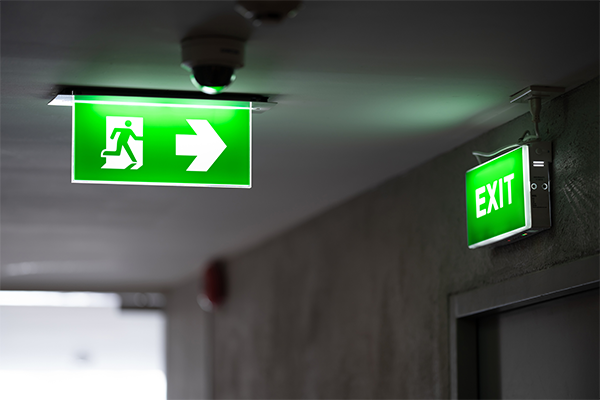
Even though codes vary by jurisdiction, most egress requirements come down to three consistent factors:
- Occupant load and how the space is used: The more people a space may serve—and the more complex the use—the more the egress route needs to support safe flow. Changes like additional workstations, expanded seating, or new storage layouts can also shift what’s required.
- Exit arrangement and travel path conditions: Egress routes need to be arranged so people can reach an exit quickly without relying on a single path that could be blocked or cut off. Routes should stay clear and intuitive for employees, customers, and visitors alike.
- Capacity and component performance: Door and corridor widths matter, but so does function—doors should operate predictably under pressure, and secured or controlled openings must behave appropriately during emergencies.
What codes and standards apply to egress?
For many commercial buildings, the NFPA 101 Life Safety Code is a primary reference for egress because it outlines how buildings should support safe evacuation across a wide range of occupancies and conditions. It addresses the fundamentals that shape day-to-day compliance, such as how exits are arranged, how the egress path is maintained, and how doors along the route should operate during an emergency. It also overlaps with related life safety topics to keep egress from seeming like “just an exit sign issue.”
While NFPA 101 is a leading standard for emergency egress, most areas don’t rely on that code alone. Egress requirements are typically applied through a combination of adopted codes, local amendments, and interpretation by your Authority Having Jurisdiction (AHJ). In other words, your building’s requirements depend on what your state, county, or city has adopted—and how those rules are applied locally.
In addition to NFPA 101, egress requirements are often influenced by:
- Additional NFPA standards like NFPA 1, 70, 72, 80, and several others
- The International Building Code, Chapter 10: Means of Egress
- OSHA standards for workplace emergency exit routes
- Americans with Disabilities Act (ADA) accessibility standards
- Local building codes and fire codes adopted and amended by your AHJ
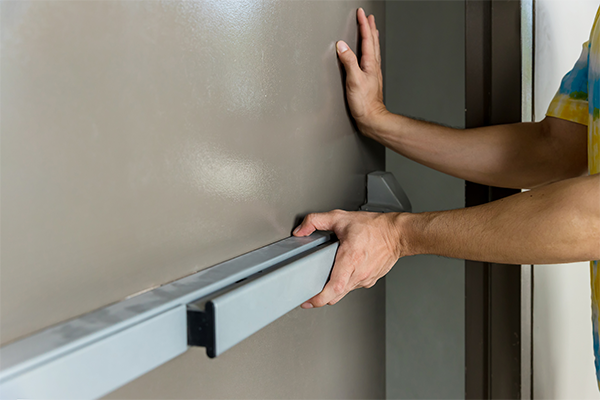
What are the key components of emergency egress in commercial buildings?
The reliability of any means of egress depends on whether the full route stays clear, usable, and consistent from day to day. Even if your building was designed correctly, small changes—like storage habits, tenant buildouts, or door hardware updates—can affect how well each route performs during an emergency. A simple way to stay ahead of issues is to evaluate your means of egress by component and confirm that the path works as a single continuous system.
Doors
Doors are one of the most common failure points because they’re where people transition between spaces. In an emergency, doors should be easy to find, easy to open, and predictable in how they operate. If a door creates hesitation or bottlenecks, evacuation slows down, and crowd pressure can increase.
Corridors and aisles
Corridors and aisles often drift out of compliance over time because they’re shared spaces that may be used for storage. Even small narrowing points can slow movement when people are evacuating in groups. Keeping these paths open and intuitive helps occupants move quickly, especially if visibility is reduced.
Stairs and ramps
Stairs and ramps are critical for changes in elevation, but they often become egress pinch points. Because movement is naturally slower on stairs and ramps, transitions into and out of these areas should be clear and predictable. Small obstructions or maintenance issues can create delays during an evacuation.

Exit discharge
Egress doesn’t end once people reach the exterior door—they still need a clear route away from the building. Exit discharge is often overlooked, but it’s where site conditions, gates, loading areas, and seasonal hazards can create problems during an evacuation.
Emergency and exit lighting
Egress routes only work if occupants can see their path options and identify exits quickly, especially in interior areas with limited natural light. Emergency and exit lighting help occupants evacuate safely when normal lighting fails or visibility is limited by smoke.
Are egress windows used in commercial buildings?
In most commercial buildings, egress is primarily achieved through doors, corridors, stairs, ramps, and a clear exit discharge path. Egress windows are better understood as a secondary option that may apply in commercial properties with sleeping rooms or dwelling units. Whether they’re required depends on the adopted codes and your AHJ’s interpretation.
How can I maintain my building’s means of egress?
You don’t have to be a code expert to keep your building’s emergency egress routes in good shape. The most reliable approach is a quick, consistent walkthrough that helps you catch changes as they happen—not just when a fire inspection is coming up. When you treat egress as an “always-on” condition, you’re far less likely to get surprised by a last-minute deficiency.

Here are a few practical checks that can help you keep your walkthroughs consistent:
- Walk the route like a first-time visitor: Start from an occupied area and follow the exit access path without “inside knowledge.” If the route isn’t obvious, you may need clearer wayfinding, a better path layout, or updated directional signage that reflects how the building is used today.
- Check the route for uninterrupted usable space: Instead of thinking “Is there an exit?”, think “Can a group move through here quickly?” Look for places where people would have to funnel, sidestep, or stop—especially near turns, doorways, and transitions into stairs or ramps.
- Operate doors the way people will use them in an emergency: Don’t just confirm doors open—confirm they open smoothly and predictably. Pay attention to sticking, delayed latching, inconsistent operation between similar doors, and anything that could create hesitation when people are moving quickly.
- Confirm that secured or controlled doors behave as expected: If any doors are locked or controlled by an access control system, verify that the system behavior aligns with local requirements. This is also a good place to confirm that hardware or programming changes didn’t accidentally create new barriers.
- Finish the route outside using the exit discharge: Step through the exterior door and keep going until you reach a safe area away from the building. Confirm that gates, barriers, loading activity, and seasonal conditions won’t restrict movement or push occupants into hazards.
A simple cadence works well for most commercial environments: monthly for high-traffic or frequently changing spaces, quarterly for more stable buildings, and any time you make layout, door, or occupancy changes. Pick one or two routes that represent how occupants actually move through the building, then walk it start to finish. If you manage multiple suites or tenant areas, repeat the same process in each space to ensure each location is protected.
Fortify your emergency egress with FSS Technologies
Emergency egress is easier to maintain when you have a clear process and the right support behind it. If you’re unsure which requirements apply to your building, or you’ve made recent changes that could affect exit routes, an experienced life safety team can help you verify what’s required and what should be addressed next. You don’t have to sort through it alone.
FSS Technologies provides full-service fire and life safety support, including consultations and ongoing service that help keep your building prepared and compliant. If you’d like help evaluating your means of egress, navigating AHJ expectations, or confirming that doors, routes, and lighting work together as one continuous life safety system, contact our team today.
Explore Our Other Blogs
What are BDA Systems?
As technology continues to evolve and building codes grow more stringent, bi-directional amplifier (BDA) systems are no longer just a luxury—they’re a critical component in ensuring your building’s safety and compliance. Whether you’re a property owner, facilities manager, or contractor, understanding BDA systems is essential, and choosing the right partner for installation makes all the difference….

Professional vs. Self-Monitoring: Cost Comparison
We recently talked about the various codes required for your security and fire protection systems. We also talked about why monitoring is vital as part of a business’s fire safety system—mainly because the code may require it. This blog will address the pros and cons of self-monitoring your business’ entire alarm system versus the cost of professional security monitoring. First, what is the difference between the two? Professional vs. Self…
Fire Alarm Troubleshooting Tips
Your commercial fire alarm system plays a critical role in protecting your building, occupants, and operations. When it works as intended, it provides early warning and supports a safe, coordinated response from your team and first responders during an emergency. When it doesn’t, even small issues can lead to compliance concerns, inspection findings, or unnecessary…

Security Cameras Are Not Created Equal
The Difference in Security Cameras Cameras are one of the most critical components in your security arsenal, and not all security cameras are the same. Why you ask? Consider these differences: Various types and sizes of cameras Indoor vs. outdoor cameras Cameras that are easy to camouflage Cameras that provide high-quality video footage Wired cameras vs. wireless…

Best Security System Setups for Senior Citizens
According to the American Association of Retired Persons (AARP), nearly 90% of senior citizens want to stay in their homes as they age even if they need day-to-day assistance or have ongoing health issues like early-stage Alzheimer’s or dementia. Unfortunately, criminals often target senior citizens as victims. Thieves assume older people will not be able…

POTS Phase-Out: Impact on Life Safety Systems
When businesses hear about the POTS line phase-out, they often think only of desk phones. In reality, traditional copper phone lines have supported a much wider range of building systems, including fire alarms, security systems, elevator phones, and more. As carriers continue moving away from copper infrastructure, those connections may become more expensive, less reliable,…

5G Security Concerns & the 3G Sunset
Consumers are using the internet on the go more than ever. By 2022, it is projected that consumers will utilize nearly 11GB of data per month, primarily due to video consumption. To create a more robust and long-term solution, technology infrastructure is working towards the next generation of mobile networks: 5G. With this network upgrade…

The Risky Business of Ring’s Vulnerable Security
If you are like the rest of Americans, you have noticed that the Ring Security company has been in the news lately— and not for anything useful. Between security hacks and lawsuits, the company has landed itself in hot water. Surveillance Camera Hacks Homeowners have security cameras installed in their homes to give them peace…
Professional Security Camera Installation Benefits
Why You Should Hire a Professional Security Camera Installer If you are not an audiovisual professional, installing quality, capable home security equipment can be a much bigger ordeal than you anticipated. The DIY home security systems advertised on television look easy to set up and install. The truth is that we’ve received many calls from…

Why Cheaper Isn’t Better When It Comes to Security
What is DIY Security? The development of home security technology using wireless transmission connections and battery power has made it possible for DIY options to enter the home security market. One of the biggest misconceptions about DIY home security is that it is so easy that a person with absolutely zero background on audiovisual equipment…