Why Are Fire Hydrants Different Colors?
The eye-catching colors of a fire hydrant are hard to miss, whether you’re walking through a city or driving around a neighborhood. What many don’t realize, however, is that these colors are integral in helping emergency responders identify and assess their available resources when preparing to fight a fire. Fire hydrant colors are distinct to make them stand out and provide information to those who need to inspect or use them. Learn how fire hydrants are classified and what their colors represent.
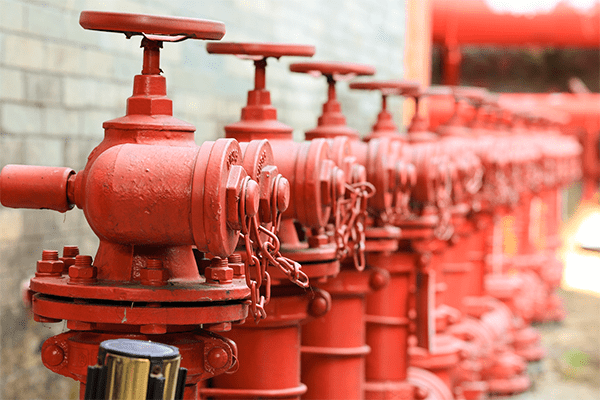
How are fire hydrants classified?
The National Fire Protection Association (NFPA) publishes and updates various codes and standards to help formalize how fire safety system elements are installed, inspected, and used. NFPA 291, Recommended Practice for Water Flow Testing and Marking of Hydrants, is the specific standard that addresses why and how hydrants should be classified and marked. Along with other NFPA codes, NFPA 291 helps promote and unify fire safety standards for commercial and residential settings.
When a new building or structure is built, fire codes require the area’s water supply to meet a specific fire flow. The NFPA defines fire flow as the “flow rate of a water supply, measured at 20 psi residual pressure, that is available for firefighting.” This rating is usually calculated based on the needs of a single building, but it can often include allowances to provide support if a fire spreads to nearby structures.
Factors that additionally influence fire flow include:
- Area of the building
- Fire resistance ratings
- Type of construction
- Occupancy of the structure
- Presence of fire sprinklers
Based on this requirement, one large-capacity hydrant or several lower-capacity hydrants may be needed to meet a structure’s fire flow, but they rarely appear in immediate clusters. Public fire hydrants in residential areas are often spaced out every 800 feet, and each hydrant must be within 600 feet of a dwelling. In commercial settings with a higher concentration of people in a smaller area, fire hydrants must be within 400 feet of a building and no more than 500 feet away from other hydrants.
With a structure’s fire flow in mind, the main factor that determines how a fire hydrant is classified is its rated capacity. Measured in either gallons or liters per minute (gpm or L/min), the rated capacity of a hydrant is what determines its classification into one of four categories: AA, A, B, and C. Once a fire hydrant is inspected and tested for capacity, it’s painted in a specific set of colors with optional additions to convey its specifications to first responders.
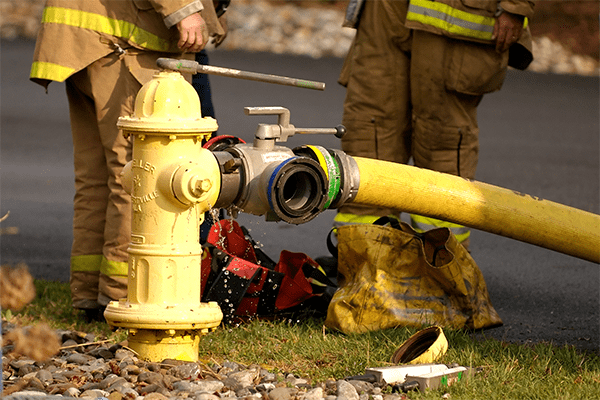
What do the different colors mean?
Generally, NFPA 291 recommends that the barrel of a fire hydrant be painted yellow. Reflective paint is an additional benefit for emergency responders who need to identify available hydrants at night or in low lighting. If an entire fire hydrant is painted red or yellow, it is either a privately owned hydrant or a public hydrant in a jurisdiction that has previously adopted a different set of color guidelines.
When looking at a fire hydrant, the color of its top and side parts relays critical information to firefighters. Sometimes called the bonnet, the top part of a hydrant is painted a specific color to indicate the flow capacity available. The caps on each connection are also painted the same color, so the barrel of the fire hydrant is different from its tops and caps. These are the four colors recommended by the NFPA and what they indicate.
A fire hydrant with a light blue top and caps is categorized as a class AA hydrant. These hydrants offer the highest water flow rate for firefighters, with a minimum flow of 1,500 gpm or 5,700 L/min. Due to the vast amount of water available, these hydrants are the best resources for fighting fires in large properties or multi-story buildings.
A fire hydrant painted with a green top and caps is a class A hydrant. The water flow rate for these hydrants ranges from 1,000 to 1,499 gpm or from 3,800 to 5,699 L/min, meaning they can cover the standard fire flow of most structures.
Orange paint on a fire hydrant identifies it as a class B hydrant. These flow rates range from 500 to 999 gpm or 1,900 to 3,799 L/min, so they’re better suited for residential settings or smaller structures.
A fire hydrant with red paint on its top and caps falls in class C, with a maximum flow rate of 500 gpm or 1,900 L/min. Because these are the weakest of the four classes, class C fire hydrants may need to be used in groups to meet a structure’s fire flow.
While the NFPA standardizes these color schemes, NFPA 291 does include notes for several exceptions to its guidelines. In general, these color codes are recommended for public fire hydrants. The code specifies that private hydrants can be marked at the owner’s discretion in a private area. However, if a private hydrant is located on a public street, the NFPA recommends that it be painted red or another color besides yellow to differentiate it from public hydrants.
Additionally, some jurisdictions or municipalities can choose to adopt a different set of colors for their fire hydrants. Colleges and universities, for example, often use their official school colors to decorate fire hydrants on their campuses. In these instances, local fire departments can find additional markings on the hydrants or receive a guide from the institution’s facilities department on their hydrants’ classifications.
Cities may also opt for specific colors that do not align with the guidelines in NFPA 291. Most commonly, local municipalities will paint the barrel of a fire hydrant with the indicator color instead of the top and caps. Silver and white are widely used as a substitute for yellow as well.

Are there other guidelines for fire hydrant markings?
In addition to the recommended color schemes, the NFPA outlines some guidelines for how additional information can be conveyed on a fire hydrant:
- Temporarily out-of-service fire hydrants should be wrapped, covered, or otherwise marked unusable.
- Permanently inoperative fire hydrants should be removed.
- Fire hydrants tested below the threshold of 20 psi should have their rated pressures stenciled in black on their tops.
- Class AA fire hydrants may have their rated capacities stenciled on the tops to ensure they’re conveyed to first responders.
- Groupings of fire hydrants may benefit from markings that designate the group-flow capacity.
Regardless of whether you follow the NFPA’s color choices, any fire hydrant must be tested and inspected regularly to ensure it works properly in an emergency. With FSS Technologies, staying on top of your commercial fire safety system is a breeze. Our service technicians can help you prepare for fire inspections, from ensuring your fire hydrants are cleared and marked to checking your building’s interior for common fire safety violations. Additionally, we can assess your building’s interior and exterior systems while referencing NFPA standards for commercial fire protection to attain or maintain your company’s fire code compliance. Contact us today to get started.
Explore Our Other Blogs

Elements of a Business Security System
How can I secure my business? A business security system needs to protect people, property, and assets from theft, crime, and fire at all times of the day and night. The people walking in and out the doors of a business are not only its owners, but customers, employees, vendors, and suppliers who have varying…

Best Small Business Security Systems
While no two small businesses are the same, they share commonalities when it comes to what they want in a security system. Most small business owners want to do three things: Protect their people, property, and assets from fire Protect their people, property, and assets from theft See what is happening in their business even…

The Top 5 Reasons Why Your Smoke Alarm Is Beeping
One of the most critical components of any fire safety plan is the humble smoke alarm. Yet, few things are more disruptive (and potentially alarming) than a smoke alarm that won’t stop beeping. Whether you manage a bustling office, run a multi-unit residential property, or hear smoke detector beeps in your own home, understanding why…

Monitored vs. Unmonitored Security Systems
If you’re thinking about installing a security system, you may be wondering if monitoring is a necessary feature. While an unmonitored system is better than nothing at all, there are some critical things you should consider before making a decision. The Benefits of Monitoring The noise and commotion caused by the sirens and lights associated…

Renter’s Insurance Discounts and Security Systems
Home invasions or burglaries are a threat to any household, regardless of where they are located. One of the biggest deterrents for burglars is a home security system that could record evidence of their actions or could notify the authorities at the time of a break-in. This is a huge motivator for homeowners when deciding…
When Is Automatic Fire Detection Required?
A fire detection system is a good idea for your property, and many insurance companies offer discounts based on your level of protection. While not required in your private residence, the law does require automatic fire detection in a wide array of other facilities. Local Building Code Requirements Your state’s building code will spell out…
Can Motion Sensors be Triggered by Light?
Motion sensors are a common part of our world today. Wave your hand under the faucet and the water runs. Pull open the closet door and the light turns on. Walk near the doors of the grocery store and they automatically slide open. Motion sensors are devices that detect movement. They are common features in…

Wired vs. Wireless Security Cameras
Wired or Wireless? When we talk about wired versus wireless in-home security, it has little to do with whether a piece of equipment has physical wires attached to it. The terms wired and wireless refer to the communication signal that is transmitted from one piece of security equipment to another. For a security system to…

How to Make Your First-Floor Apartment Safe
In business, getting in on the ground floor is great. You are part of a plan early on to gain an advantage. When it comes to apartment-dwelling, however, getting in on the ground floor is only an advantage in some respects. It’s easier for you and your pets to get in an out, it’s easier…

Smoke & Carbon Monoxide Detector Lifespan
As with pretty much everything, your smoke alarm eventually expires. Sensors can become less sensitive over time, making them less adept at doing their job: detecting smoke, carbon monoxide, or potential fires. Replacing the equipment in your fire safety system is important both at home and in your business. We have developed a quick guide…